The Saint Louis Science Center envisions an equitable and inclusive society where people are passionate about science and use it to improve lives, transform communities and empower future generations. Through exposure to STEM concepts and recognition of contributions made by members of various communities, we aim to inspire and empower individuals from all backgrounds to pursue and thrive in STEM fields.
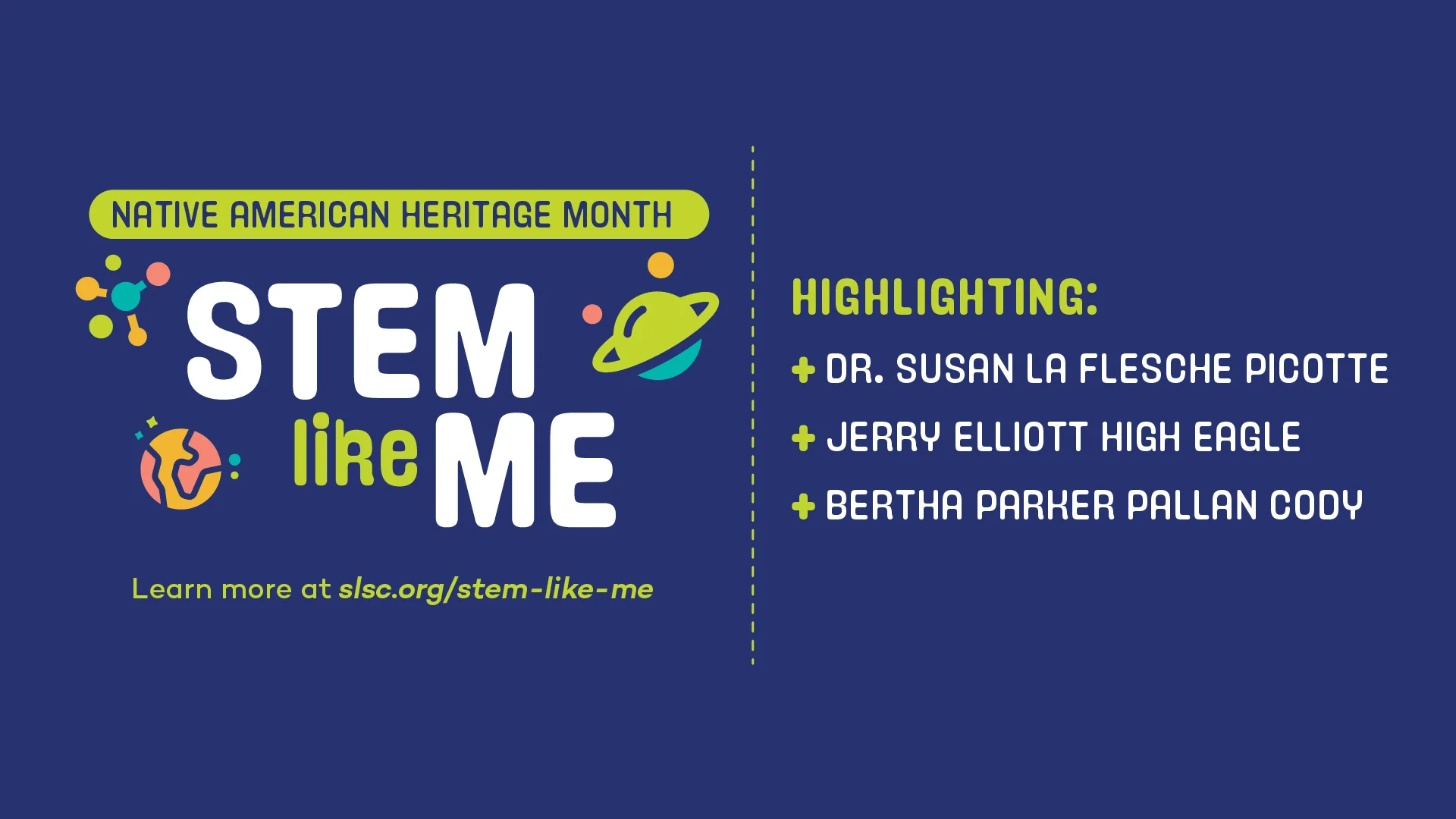
This November, as we celebrate Native American Heritage Month, we’re recognizing a few STEM-sational individuals who’ve inspired us all to make an impact. Highlighted this month are:
- Dr. Susan La Flesche Picotte
- Jerry Elliott – High Eagle
- Bertha Parker Pallan Cody
Dr. Susan La Flesche Picotte – First Native American woman to earn a medical degree (1865-1915)
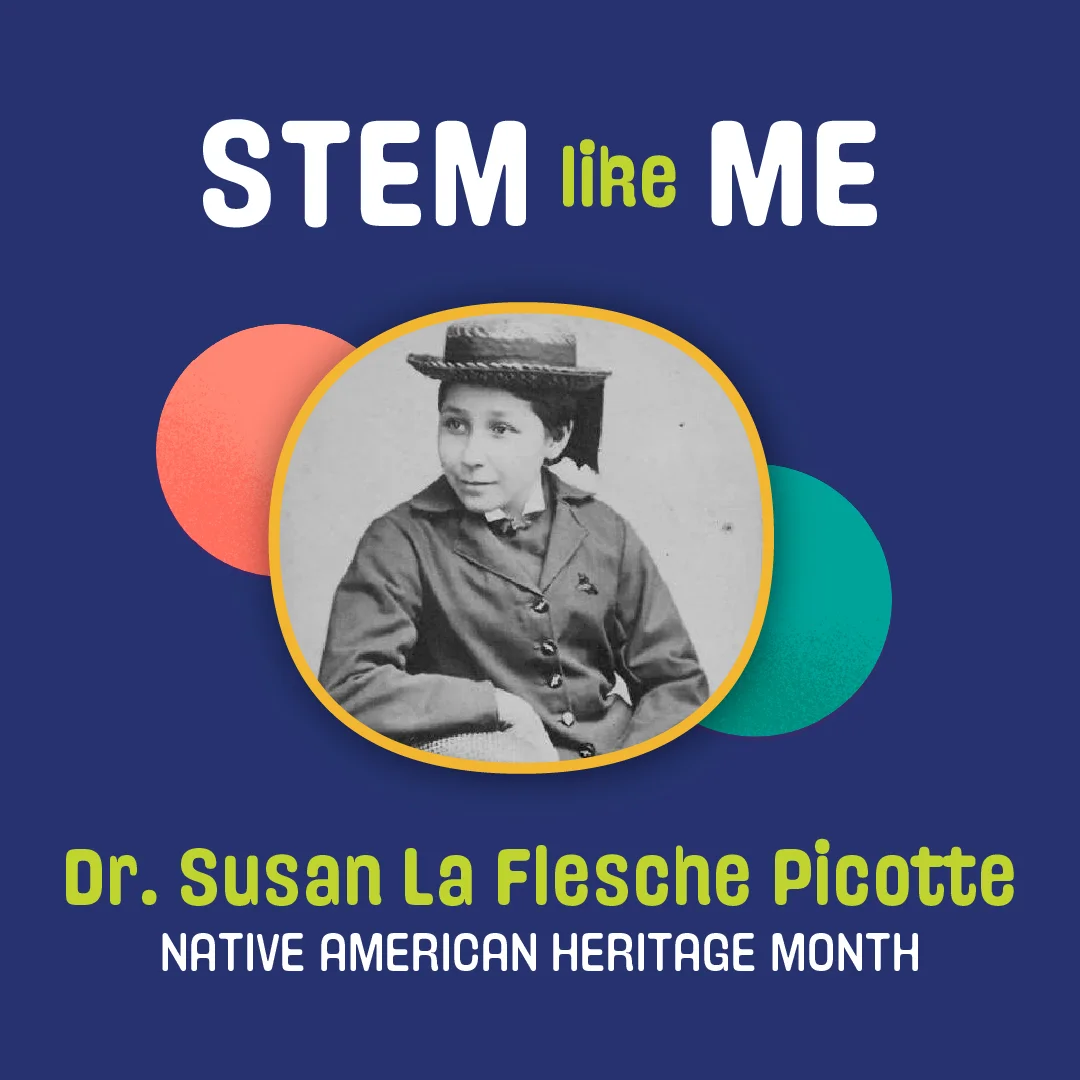
Dr. Susan LaFlesche Picotte was the first Indigenous women (and possibly the first Native American person) to earn a medical degree. After graduation, she dedicated her service to the public health of members of the Omaha tribe for which she belonged and established the first privately funded hospital on a Native American reservation. She was also an outspoken critic of the way the American government treated Native Americans.
La Flesche Picotte was born on the Omaha Reservation in Nebraska to parents with Omaha and European ancestry. Her father, Joseph (also known as Iron Eye) became the last formal chief of the Tribe in 1855 and encouraged his children to follow the practice of assimilation into the “white world,” while also incorporating the traditions of the Omaha heritage. This continued in her early education, as she attended a mission school on the reservation, where Native American children were taught by European Americans, until age 14 when she moved to the Elizabeth Institute for Young Ladies in New Jersey for three years. She returned to the mission school at age 17 and taught students there before moving to the Hampton Institute in Virginia (considered one of the nation’s first and best schools of higher education for non-white students) to study. She graduated from the Hampton Institute as the salutatorian in 1886.
She was moved toward an interest in the medical field after observing a white doctor refuse to successfully treat a Native American woman who died soon afterward, and La Flesche Picotte applied to several medical schools. She was accepted to the Woman’s Medical College of Pennsylvania, one of the few medical schools in America that accepted women at the time. She sought financial assistance to attend the school from the Women’s National Indian Association and became what is believed to be the first person to receive aid for professional education in the United States. She studied and completed clinical work around Philadelphia and at home on the reservation during her three years at the school. She graduated in 1899 as the valedictorian of the class and applied to serve as the government physician for the Omaha Reservation instead of better-paying and more comfortable opportunities along America’s East Coast.
In this new role, she championed for improved public health conditions among the reservation, lobbying for more stable housing, the installation of screens to limit insect-borne disease transmission, a reduction in alcohol consumption, and more hygienic practices among her patients. The reservation brought forth more than 1,200 patients and covered hundreds of miles, leading to long days and constant work. Beyond medical care, she helped individuals communicate more effectively against government bureaucracy and fight for payments when lands were lost due to a treaty signed with the Office of Indian Affairs.
Working on the reservation for several years after graduation, she resigned in 1893 after becoming sick herself and then caring for her dying mother. She met Henry Picotte at this time and married him in 1894. Following the birth of two sons soon after, she returned to medicine and opened a private practice in Bancroft, Nebraska. A few years later, in 1913, she opened the Omaha reservation’s first hospital in Walthill, Nebraska, which served both the Omaha tribe and white patients.
Dr. La Flesche Picotte died two years after that hospital opened from chronic illness and declining health, but the hospital continued to serve patients until its closure in 1945. It was transformed into a National Historic Landmark in 1993 and serves as a museum dedicated to her work and the history of the Omaha tribe.
For more information:
Jerry Eliott – High Eagle – First Native American to work at NASA, played critical roles in several spaceflight missions (1943-Present)
As a child, Jerry Eliott was inspired to help men land on the moon, and he continued that drive to become one of the first Native Americans to work at NASA. He started a 41-year career in the Gemini Program and continued with critical roles in several Apollo missions, including the Apollo 11 mission that landed on the moon and the safe return of the crew during the Apollo 13 mission.
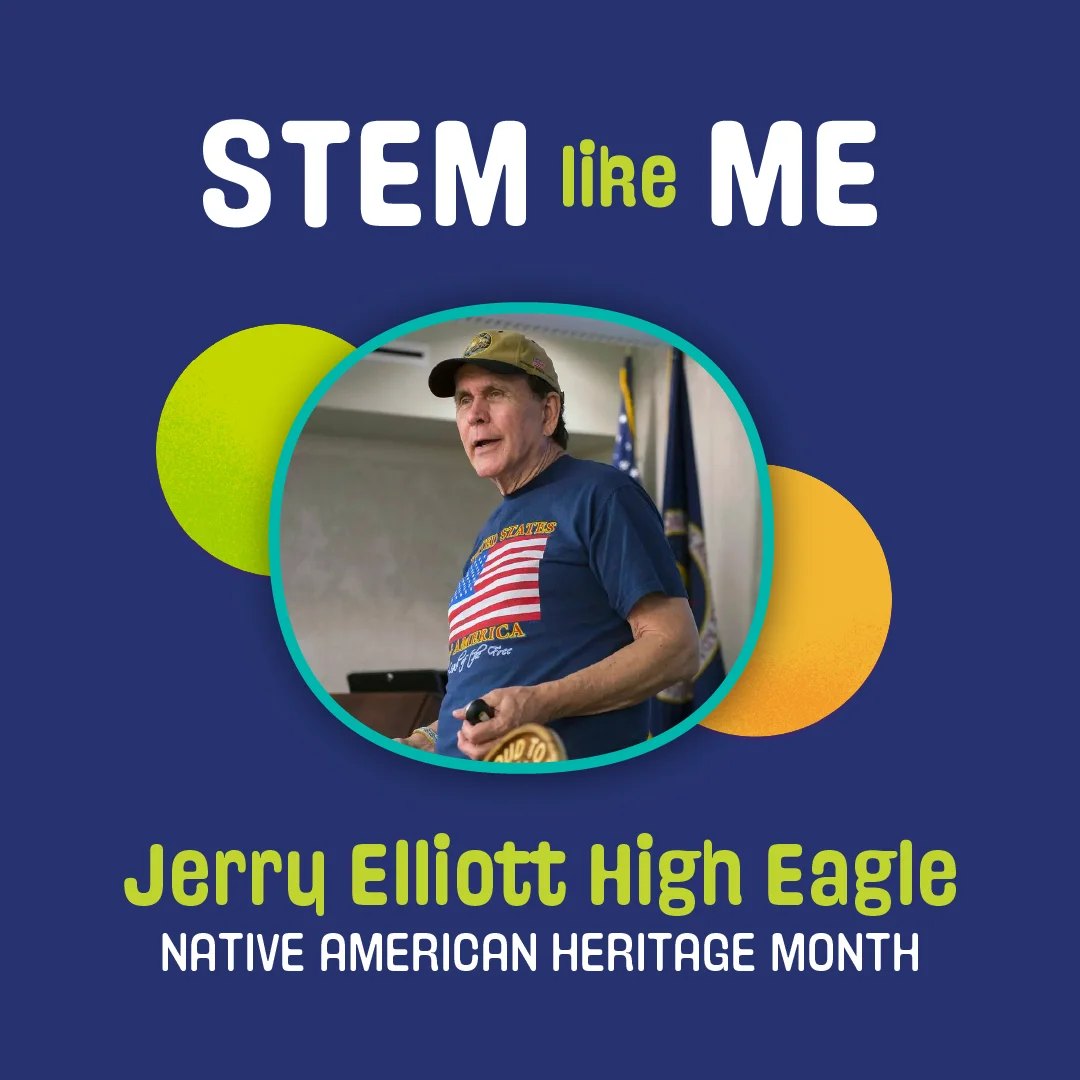
He studied at the University of Oklahoma but underwent many difficulties during this period. He faced racial discrimination and disrespect from students and faculty but became the first Indigenous individual to earn a physics degree from the university in 1966, as well as a minor in mathematics. However, the death of his stepfather and a lack of funding did not allow him to seek further education. Instead, he was moved by finding a poster on a bulletin board that NASA was on campus and looking to hire.
Eliott arrived at NASA’s Mission Control Center in Houston, Texas, in April 1966. His first role as a guidance engineer with the Gemini Program. He then became Guidance, Navigation and Control Engineer for the Apollo Program at Mission Control, assisting with the guidance and landing of the lunar module. After a promotion to Retrofire Officer, his role was to compute the mission’s return-to-Earth trajectories. His childhood inspiration came true as he was in the Mission Control Room for Neil Armstrong’s first step on the moon in June 1969. Following the Apollo Program, Eliott participated in every NASA program launch—including Skylab, the Apollo-Soyuz joint mission, the Space Shuttle Program, and the International Space Station—until his retirement.
Eliott worked on 11 Apollo missions, but his service during Apollo 13 was crucial to the safe return of the astronauts. When the mission was disrupted by failures to the oxygen supply and electrical system, Eliott’s job was to develop a rescue plan and return trajectory. For his role in the mission, Eliott was awarded the Presidential Medal of Freedom, the highest civilian award, by President Richard Nixon.
In the 1970s, Eliott expanded his efforts to support Indigenous people. He partnered with two others to form the American Indian Science and Engineering Society to further the involvement of Native Americans in STEM. Today, this organization enjoys more than 5,000 members and has awarded millions in academic scholarships throughout the United States. In 1976, he wrote legislation for what would become the first observance of Native American Awareness Week, and this was soon passed by Congress and put into law by President Gerald Ford. At age 41, native elders in his Cherokee Nation bestowed the name “High Eagle” on Eliott to recognize the saying that “The Eagle that flies highest is closest to God.”
After leaving NASA, Eliott formed HighEagle Technologies, which is working to treat cancer, blood-related diseases and other illnesses. He’s also an award-winning poet and author, writing numerous pieces on a variety of topics. And, he’s an accomplished musician, playing Native American instruments at concert halls across the United States.
For more information:
Bertha Parker Pallan Cody – First Native American woman to work in archaeology (1907-1978)
Despite having no formal scholastic education in the field, Bertha Parker Pallan Cody is widely considered the first Native American woman to excel in archaeology. With her smaller size, she was able to explore places on excavation sites previously blocked by larger men, and she located what was the oldest known evidence of human occupation in North America.
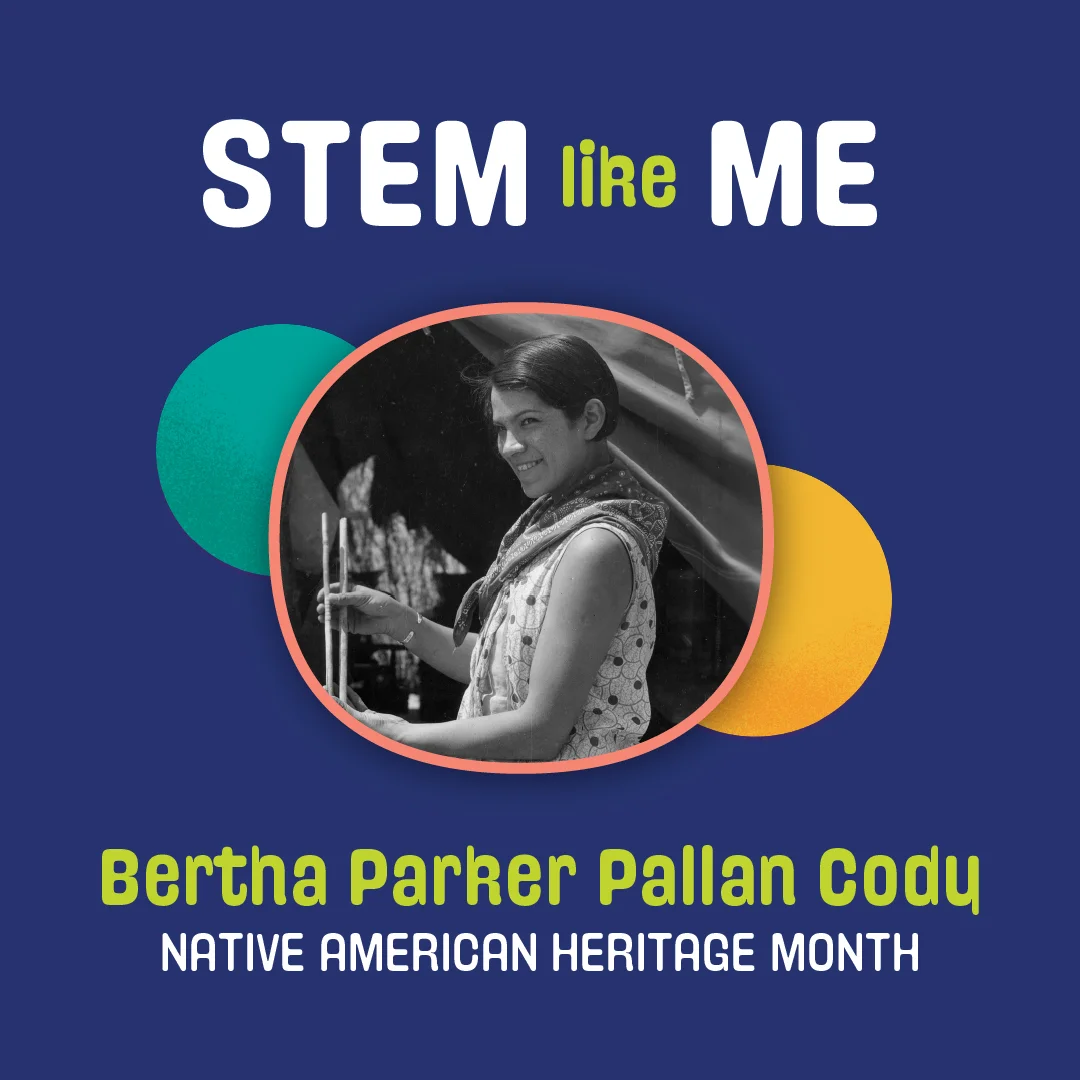
A descendant of the Seneca and Abenaki nations, Cody discovered her love for archaeology through her family. Her father, Arthur Parker was a Seneca folklorist, archaeologist and historian, as well as the first president for the Society for American Archaeology, and her mother, Beulah Tahamont, was an actress. Following her divorce to her first husband, Joseph Pallan, she moved with her mother to work excavation sites in Nevada with her uncle, archaeologist Mark Harrington, in support of the Southwest Museum of the American Indian in Los Angeles.
It is at those sites in Nevada with her uncle where her significant discoveries were made. On an expedition at Gypsum Cave, she discovered the skull of a giant ground sloth alongside human-made tools, which connected those creatures to human existence (as the 20-foot-tall animal is believed to have gone extinct in the Pleistocene era, about 10,000 BC). She later discovered an encampment nearby that dates to 5000 BC. Beyond those discoveries, she worked as an Archaeology Assistant for the Southwest Museum where she cataloged artifacts, developed field reports, and interviewed Native inhabitants with a conscientious and caring manner that was not the case for non-Native researchers in that field. She also published several papers in the museum’s Masterkey journal.
Her time in the cave system exposed her to bat guano, which caused an illness to Cody and the death of her second husband, James Thurston. She left the museum and became active in Hollywood’s show business, serving as a technical advisor for Native American roles in movies and television programs. She then met and married actor, “Iron Eyes Cody,” an Italian American who played appeared in more than 300 roles, including one as a crying Native American in a PSA for the Keep America Beautiful campaign. The couple later established the Los Angeles Indian Center, an institution designed to support the culture of American Indians, Alaska Natives, and Native Hawaiian people in Southern California.
For more information:
Subjects